
| WindWalker Pugs |
WindWalker Pugs is an AKC Registered Kennel Name.
Close this browser window to return to your previous page on the WindWalker Pugs site!
Evaluating show puppies is a lengthy process. Obviously, we look at them from the moment they are
born in hopes of finding “the one” that will go on to be that Best In Show Winner, but the truth is
they change so much, it is nearly impossible to tell what you really have until they are at least 8 – 12
weeks old.
How I evaluate my pups is based upon the lines I’m working with. Other breeders establish their own
“rules” and my methods may not work for everyone, especially if their Pugs are not related to mine. I
have had enough litters that I can usually tell my show prospects by around 10 -12 weeks of age.
The first thing I look for is size and shape of their heads. Width of underjaw, bite, placement of
nose, ears, and size of ears and eyes play an important role in “who’s who in the zoo.”
If you are familiar with the Illustrated Standard on the Pug Dog Club of America’s web site, the terms
and traits I’ll be using will be much easier to understand. You may want to go to that site and print off
a copy for this discussion.
Second to head traits in my book are the body traits. It is probably second at this point in my
breeding program, because I feel Pugs are “a head breed” and as a general type, show breeders seem
to be getting away from the traditional Pug head, much to my dismay. However, the Pug pup’s body is
absolutely key to having a good sound representative of the breed for showing and breeding.
I typically see nice bone and substance starting at six to eight weeks. At this time I will see nice
short backs, too, on most of my pups. So, heads are the first thing I look at, starting at about 10
weeks of age.
How far apart are the eyes? Wide set large eyes, with little to no white around the edges are
important to me. I think our Pugs’s eyes are getting smaller all the time, and away from the standard’s
ideal. A good eye may be prone to eye problems, if not completely correct, so this may be the reason,
but a good eye can be seen on my boy Tyler (see below). Large, round, not protruding, soft in
expression, expressive, and very dark brown.
Are the center of the eyes even with the top of the nose? Do the ears tips even with the corner of
the eyes? These are the things I watch for, along with any noticeable problems with excessive tearing.
Head shape, should be as square as possible to me. This happens when there is a nice width of
underjaw, the look of a square, blocky head. Ears should be set high enough there is no “dome” to the
top. Wrinkles are nice at this age, but I don’t expect them. Even the indication of where they will be
is nice before 10 weeks, and I’m looking for the start of wrinkles, and a nose roll that covers the “bee
sting” (bump above the nose) by 12 weeks.
Next would be the evaluation of the pup’s body. Bone is key in a show puppy. A pup at 12 weeks should
have nice bone for their body. It usually isn’t as much as they had at 8 weeks, especially with the girls.
Just don’t assume they will get more. It can happen, and I’ve seen it, but I never assume it. Most of
the girls do not, and the majority of the boys, but anything is possible after sexual maturity.
Length of back and correct (level) toplines come next. Followed by correct lay of shoulder, rib cage
placement and tail set. Any of these can be a deal breaker for me, and of course check those boys for
their testicles, since it isn’t likely they will descend properly after 12 – 16 weeks of age. Nothing is
worse than having the beautiful new show male pup suck one up into the abdominal cavity AFTER you’
ve started planning that boy’s show career.
Movement can now start to be evaluated. Watch how they move on a level surface coming towards you,
and away. Watch the side movement. After observing them move naturally, teach the pup to walk and
trot on a lead. Once the pup is comfortable with the lead, have someone else watch the pup move, then
have them move the pup while you watch. What do you both see? Is the front clean or hack-kneed? Do
they move in a straight line, throw out a leg? Do they move cleanly in the rear? How do they gait? How
do the stack themselves? Anything other than a clean natural mover and free stacker should be
monitored closely and continuously before you make your final decision.
Last, but for showing purposes not least, we come to the cosmetics of the pup. If you want to win in
the ring there will be some cosmetic traits you need to be aware of, but things that you may want for
your breeding program that are out of style with the judges. Let’s face it, the lovely clear light coats
are pretty, and the double curl tail perfection, but what about pigment? Clear nails are no big deal to
some breeders, but in my opinion, just the beginning of other pigment problems. You must decide what’
s important to you, winning, or breeding, or both.
We each have a type in our mind’s eye that we breed to, that is within our interpretation of the
standard. The traits we have, what we want, what we consider out of the question, what we don’t mind.
All these decisions will make or break us in the ring, and as breeders. Some can be changed or fixed
quite easily, others will take years to remedy. We must understand each trait, how it contributes to
the overall balance of the Pug, and what the alternatives are.
Example, you have a girl that needs some pigment on her toenails. You find a stud dog that has black
nails. What do you think the resulting litter will give you? How important are the toenails when you
consider the rest of the dog’s traits? Do you know if the dog has light nails behind him? Do any of his
siblings have them? Research may or may not result in good solid information, so what are you willing
to risk?
In conclusion, I look for solid blocks, or chunks, with good balance and movement, short backs, level
toplines, heavy bone, large wide heads with wide eyes and underjaws, good pigment, proper shoulder
layback, correct rib placement, tails held tight to the body (curls come later), and a energetic outgoing
personality. I wait till the pups are 12 weeks to decide who I’m placing as a pet (unless it’s obvious
before then), I keep my prospects a month or two longer to see how the awkward “preteen stage”
affects them, and I do my final evaluation at about six months. If they aren’t looking good at six
months, I’m not willing to spend the money to put them in the ring. If I do, I give them until about
two years of age, and decide if I will use them in my breeding program. I’ve spayed and neutered
finished AKC champions that I never bred, and I’ve sold as pets, all the pups from others. It’s not
easy, but the key is to be discriminating. Better to avoid problems with undesirable traits than spend
countless generations trying to eliminate them from you future litters.
Preparing To Show Your Pup
Now that you have that special pup, what's next? What equipment do you need to get started with
that special new pup? The right show lead is the most important piece of equipment needed to show
the dog. Second, is good grinder to keep those toenails nice and short. Third, in my opinion, is a really
good pair of thinning shears. I would assume you already have a nice brush, even pets need a good
brushing on a regular basis, but I also like a nice metal flea type comb for removing dead undercoat.
Next, you need some kind of crate, unless you're only taking one Pug to the ring, and you don't mind
hold it for several minutes during the down time outside the ring. If you bring a crate, you'll probably
want a crate dolly. Of course no one starts off with all that, but one dash to the ring from the
parking lot, carrying a dog to avoid mud puddles, in the pouring rain, and you'll figure out it's easier to
pull the dolly while your Prince, or Princess, rides safely inside the dry plastic crate. If you have a big
coat with a hood (I live where it rains a lot), with a grooming coat over your show clothes, can prevent
arriving with a soaked, mud caked show dog, too, so it's up to you how you want to arrive at the ring.
Ring side, some folks carry a chair and/or grooming table, tack box for those last minute touch-ups,
or wipe-downs, as I call it, water bottle for you and your Pug, and any additional weather appropriate
equipment. These might include a battery operated fan, cool matt, etc., whatever you need to be
comfortable and ready to show your dog.
All this extra stuff, however helpful, is just along for the ride. The only thing you need is that show
lead, and the dog, of course!
Training your puppy for the ring is also required. When you first select your pup you need to work
especially hard to get them out and about to socialize them to new situations, sights and sounds. I like
to take mine to Home Depot or PetSmart. Just know that at PetSmart they will be admired and you'll
have to talk to people who will ask you lots of questions. At Home Depot there is less attention paid
to a puppy in one of their larger and deeper carts. I take a pad along in either case to keep them from
getting a paw caught in the holes in the bottom of the carts. In warm weather, you can also walk them
on the sidewalk in front of most stores. This gets them leash training and socialization.
A handling class for conformation is usually offered by your local all breed dog club. You can find the
contacts for these organizations on the AKC web site. If you contact the club's secretary for
information they can tell you how to proceed. Once or twice a week, for a month or two should be
extremely helpful for both the new exhibitor and/or a new show pup.
I start table training as soon as I can. I simply put the pup up on any flat surface and get them used
to it. In the kitchen, a piece of Rubbermaid shelf liner will make the surface less slippery and give the
pup more confidence. This is helpful if you don't have a grooming table, but any surface will work. I've
used a sturdy coffee table, footstools, etc., and I just set the pup up in a stack, and if the pup stands
still for even 5 seconds, I give lots of praise.
Small pieces of cheese or chicken, liver, whatever you'd like to use for "bait" will keep the pup's
attention, but remember, it may not be the direction to go once you're actually showing the dog. I
started using bait in the ring, but have now moved to using it as a lure to keep attention only, and only
give it to the dog after we've left the ring and the dog is not thinking about it. The reason, I want
them to focus on me, not the bait. I want them to not associate getting it as soon as we leave the
ring, so they don't try to bolt for the exit when we're going around past it. I do give them some if
they win, while we're waiting for the ribbon.
For a new exhibitor, bait is a two-edged sword in my opinion. You need to have yourself trained and
comfortable with using and moving the lead. This isn't always easy, and having a piece of meat in your
hand makes it harder. It is the reason to learn how to use it sparingly, so you're only managing a
small piece while in the ring.
Show attire isn't something anyone talks about much, but it is important if you want to be taken
seriously. As a new exhibitor, you might want to check out the Junior Handling competition. This is the
part of an AKC Dog Show that involves youngsters competing with each other on their handling skills.
There will be a wide spread on the skill level at the Novice level, but the Seniors should give you a
good idea of how the judges expect you to present your dog. Remember, in this sport you're
competing with professionals. If you expect to win, you need to present yourself in a way that shows
you're serious.
I've had the experience of attending a George Alston seminar and I can tell you some of what I've
learned over the years, but each person has to find their own way of showing. Some are more at ease,
some pick it up easier, but the bottom line, you are there to present your dog to the judge in the best
possible light. That means you should be all but invisible to the judge. Nothing you do should detract
or distract the judge's vision of your dog. Why do people complain that they lost to a professional
handler? You hear it a lot among the owner handlers. If they think they have a better dog, perhaps
they should consider improving their handling skills.
Handling involves more than taking the dog around the ring, putting it on the table, and not making
mistakes. It involves a lot of hard work from the training of the dog and how it's groomed, to
knowing how to show the dog in a manner that brings out it's best qualities. It's about looking like
you're making an effort, not waiting for a bus, while you're waiting your turn on the table. It's about
making sure the dog isn't just on the end of the leash, but presenting the best picture possible, each
time the judge's eyes are on the dog.
Watching people in the ring I sometimes wonder what they're there for. They don't even glance at
the dog, and either stand there looking bored, or chat away with those next to them, or even folks
outside the ring. The dog isn't focused, why would it be? The handler isn't focused, so why do they
expect to win? Would a participant in any other sport expect to win if they were not focused? Just an
observation.
Good manners, good sportsmanship, and good grooming never go out of style. Practice all three, learn
by observation, read up on the subject, talk to the professionals and ask questions. Focus on the dog,
keeping your eye on the judge, and observe the ring pattern the judge is using BEFORE you go into
the ring, so you don't mess up and have to be corrected.
Make sure your dog is well groomed, in good condition, and properly trained. Keep it fun, remember
this is a sport, but it's also a hobby, so it should be fun, and the dog will only want to participate if
you make it fun instead of work. Don't take yourself too seriously, it is JUST a dog show, not a
conference on world hunger. And, be prepared to lose more often than not. There are going to be
winners, but many more losers. Be a good loser and a gracious winner. It doesn't hurt to smile, no
matter who wins, and when you lose, consider smiling as practice for your future win photos.
Keep your chin up and don't listen to those that try to ruin your confidence before you walk into the
ring. It's a tactic used by those that are afraid of losing.
Always remember, your dog is still your dog, and just because the judge liked another one better, that
doesn't mean he, or she, loves you any less!
born in hopes of finding “the one” that will go on to be that Best In Show Winner, but the truth is
they change so much, it is nearly impossible to tell what you really have until they are at least 8 – 12
weeks old.
How I evaluate my pups is based upon the lines I’m working with. Other breeders establish their own
“rules” and my methods may not work for everyone, especially if their Pugs are not related to mine. I
have had enough litters that I can usually tell my show prospects by around 10 -12 weeks of age.
The first thing I look for is size and shape of their heads. Width of underjaw, bite, placement of
nose, ears, and size of ears and eyes play an important role in “who’s who in the zoo.”
If you are familiar with the Illustrated Standard on the Pug Dog Club of America’s web site, the terms
and traits I’ll be using will be much easier to understand. You may want to go to that site and print off
a copy for this discussion.
Second to head traits in my book are the body traits. It is probably second at this point in my
breeding program, because I feel Pugs are “a head breed” and as a general type, show breeders seem
to be getting away from the traditional Pug head, much to my dismay. However, the Pug pup’s body is
absolutely key to having a good sound representative of the breed for showing and breeding.
I typically see nice bone and substance starting at six to eight weeks. At this time I will see nice
short backs, too, on most of my pups. So, heads are the first thing I look at, starting at about 10
weeks of age.
How far apart are the eyes? Wide set large eyes, with little to no white around the edges are
important to me. I think our Pugs’s eyes are getting smaller all the time, and away from the standard’s
ideal. A good eye may be prone to eye problems, if not completely correct, so this may be the reason,
but a good eye can be seen on my boy Tyler (see below). Large, round, not protruding, soft in
expression, expressive, and very dark brown.
Are the center of the eyes even with the top of the nose? Do the ears tips even with the corner of
the eyes? These are the things I watch for, along with any noticeable problems with excessive tearing.
Head shape, should be as square as possible to me. This happens when there is a nice width of
underjaw, the look of a square, blocky head. Ears should be set high enough there is no “dome” to the
top. Wrinkles are nice at this age, but I don’t expect them. Even the indication of where they will be
is nice before 10 weeks, and I’m looking for the start of wrinkles, and a nose roll that covers the “bee
sting” (bump above the nose) by 12 weeks.
Next would be the evaluation of the pup’s body. Bone is key in a show puppy. A pup at 12 weeks should
have nice bone for their body. It usually isn’t as much as they had at 8 weeks, especially with the girls.
Just don’t assume they will get more. It can happen, and I’ve seen it, but I never assume it. Most of
the girls do not, and the majority of the boys, but anything is possible after sexual maturity.
Length of back and correct (level) toplines come next. Followed by correct lay of shoulder, rib cage
placement and tail set. Any of these can be a deal breaker for me, and of course check those boys for
their testicles, since it isn’t likely they will descend properly after 12 – 16 weeks of age. Nothing is
worse than having the beautiful new show male pup suck one up into the abdominal cavity AFTER you’
ve started planning that boy’s show career.
Movement can now start to be evaluated. Watch how they move on a level surface coming towards you,
and away. Watch the side movement. After observing them move naturally, teach the pup to walk and
trot on a lead. Once the pup is comfortable with the lead, have someone else watch the pup move, then
have them move the pup while you watch. What do you both see? Is the front clean or hack-kneed? Do
they move in a straight line, throw out a leg? Do they move cleanly in the rear? How do they gait? How
do the stack themselves? Anything other than a clean natural mover and free stacker should be
monitored closely and continuously before you make your final decision.
Last, but for showing purposes not least, we come to the cosmetics of the pup. If you want to win in
the ring there will be some cosmetic traits you need to be aware of, but things that you may want for
your breeding program that are out of style with the judges. Let’s face it, the lovely clear light coats
are pretty, and the double curl tail perfection, but what about pigment? Clear nails are no big deal to
some breeders, but in my opinion, just the beginning of other pigment problems. You must decide what’
s important to you, winning, or breeding, or both.
We each have a type in our mind’s eye that we breed to, that is within our interpretation of the
standard. The traits we have, what we want, what we consider out of the question, what we don’t mind.
All these decisions will make or break us in the ring, and as breeders. Some can be changed or fixed
quite easily, others will take years to remedy. We must understand each trait, how it contributes to
the overall balance of the Pug, and what the alternatives are.
Example, you have a girl that needs some pigment on her toenails. You find a stud dog that has black
nails. What do you think the resulting litter will give you? How important are the toenails when you
consider the rest of the dog’s traits? Do you know if the dog has light nails behind him? Do any of his
siblings have them? Research may or may not result in good solid information, so what are you willing
to risk?
In conclusion, I look for solid blocks, or chunks, with good balance and movement, short backs, level
toplines, heavy bone, large wide heads with wide eyes and underjaws, good pigment, proper shoulder
layback, correct rib placement, tails held tight to the body (curls come later), and a energetic outgoing
personality. I wait till the pups are 12 weeks to decide who I’m placing as a pet (unless it’s obvious
before then), I keep my prospects a month or two longer to see how the awkward “preteen stage”
affects them, and I do my final evaluation at about six months. If they aren’t looking good at six
months, I’m not willing to spend the money to put them in the ring. If I do, I give them until about
two years of age, and decide if I will use them in my breeding program. I’ve spayed and neutered
finished AKC champions that I never bred, and I’ve sold as pets, all the pups from others. It’s not
easy, but the key is to be discriminating. Better to avoid problems with undesirable traits than spend
countless generations trying to eliminate them from you future litters.
Preparing To Show Your Pup
Now that you have that special pup, what's next? What equipment do you need to get started with
that special new pup? The right show lead is the most important piece of equipment needed to show
the dog. Second, is good grinder to keep those toenails nice and short. Third, in my opinion, is a really
good pair of thinning shears. I would assume you already have a nice brush, even pets need a good
brushing on a regular basis, but I also like a nice metal flea type comb for removing dead undercoat.
Next, you need some kind of crate, unless you're only taking one Pug to the ring, and you don't mind
hold it for several minutes during the down time outside the ring. If you bring a crate, you'll probably
want a crate dolly. Of course no one starts off with all that, but one dash to the ring from the
parking lot, carrying a dog to avoid mud puddles, in the pouring rain, and you'll figure out it's easier to
pull the dolly while your Prince, or Princess, rides safely inside the dry plastic crate. If you have a big
coat with a hood (I live where it rains a lot), with a grooming coat over your show clothes, can prevent
arriving with a soaked, mud caked show dog, too, so it's up to you how you want to arrive at the ring.
Ring side, some folks carry a chair and/or grooming table, tack box for those last minute touch-ups,
or wipe-downs, as I call it, water bottle for you and your Pug, and any additional weather appropriate
equipment. These might include a battery operated fan, cool matt, etc., whatever you need to be
comfortable and ready to show your dog.
All this extra stuff, however helpful, is just along for the ride. The only thing you need is that show
lead, and the dog, of course!
Training your puppy for the ring is also required. When you first select your pup you need to work
especially hard to get them out and about to socialize them to new situations, sights and sounds. I like
to take mine to Home Depot or PetSmart. Just know that at PetSmart they will be admired and you'll
have to talk to people who will ask you lots of questions. At Home Depot there is less attention paid
to a puppy in one of their larger and deeper carts. I take a pad along in either case to keep them from
getting a paw caught in the holes in the bottom of the carts. In warm weather, you can also walk them
on the sidewalk in front of most stores. This gets them leash training and socialization.
A handling class for conformation is usually offered by your local all breed dog club. You can find the
contacts for these organizations on the AKC web site. If you contact the club's secretary for
information they can tell you how to proceed. Once or twice a week, for a month or two should be
extremely helpful for both the new exhibitor and/or a new show pup.
I start table training as soon as I can. I simply put the pup up on any flat surface and get them used
to it. In the kitchen, a piece of Rubbermaid shelf liner will make the surface less slippery and give the
pup more confidence. This is helpful if you don't have a grooming table, but any surface will work. I've
used a sturdy coffee table, footstools, etc., and I just set the pup up in a stack, and if the pup stands
still for even 5 seconds, I give lots of praise.
Small pieces of cheese or chicken, liver, whatever you'd like to use for "bait" will keep the pup's
attention, but remember, it may not be the direction to go once you're actually showing the dog. I
started using bait in the ring, but have now moved to using it as a lure to keep attention only, and only
give it to the dog after we've left the ring and the dog is not thinking about it. The reason, I want
them to focus on me, not the bait. I want them to not associate getting it as soon as we leave the
ring, so they don't try to bolt for the exit when we're going around past it. I do give them some if
they win, while we're waiting for the ribbon.
For a new exhibitor, bait is a two-edged sword in my opinion. You need to have yourself trained and
comfortable with using and moving the lead. This isn't always easy, and having a piece of meat in your
hand makes it harder. It is the reason to learn how to use it sparingly, so you're only managing a
small piece while in the ring.
Show attire isn't something anyone talks about much, but it is important if you want to be taken
seriously. As a new exhibitor, you might want to check out the Junior Handling competition. This is the
part of an AKC Dog Show that involves youngsters competing with each other on their handling skills.
There will be a wide spread on the skill level at the Novice level, but the Seniors should give you a
good idea of how the judges expect you to present your dog. Remember, in this sport you're
competing with professionals. If you expect to win, you need to present yourself in a way that shows
you're serious.
I've had the experience of attending a George Alston seminar and I can tell you some of what I've
learned over the years, but each person has to find their own way of showing. Some are more at ease,
some pick it up easier, but the bottom line, you are there to present your dog to the judge in the best
possible light. That means you should be all but invisible to the judge. Nothing you do should detract
or distract the judge's vision of your dog. Why do people complain that they lost to a professional
handler? You hear it a lot among the owner handlers. If they think they have a better dog, perhaps
they should consider improving their handling skills.
Handling involves more than taking the dog around the ring, putting it on the table, and not making
mistakes. It involves a lot of hard work from the training of the dog and how it's groomed, to
knowing how to show the dog in a manner that brings out it's best qualities. It's about looking like
you're making an effort, not waiting for a bus, while you're waiting your turn on the table. It's about
making sure the dog isn't just on the end of the leash, but presenting the best picture possible, each
time the judge's eyes are on the dog.
Watching people in the ring I sometimes wonder what they're there for. They don't even glance at
the dog, and either stand there looking bored, or chat away with those next to them, or even folks
outside the ring. The dog isn't focused, why would it be? The handler isn't focused, so why do they
expect to win? Would a participant in any other sport expect to win if they were not focused? Just an
observation.
Good manners, good sportsmanship, and good grooming never go out of style. Practice all three, learn
by observation, read up on the subject, talk to the professionals and ask questions. Focus on the dog,
keeping your eye on the judge, and observe the ring pattern the judge is using BEFORE you go into
the ring, so you don't mess up and have to be corrected.
Make sure your dog is well groomed, in good condition, and properly trained. Keep it fun, remember
this is a sport, but it's also a hobby, so it should be fun, and the dog will only want to participate if
you make it fun instead of work. Don't take yourself too seriously, it is JUST a dog show, not a
conference on world hunger. And, be prepared to lose more often than not. There are going to be
winners, but many more losers. Be a good loser and a gracious winner. It doesn't hurt to smile, no
matter who wins, and when you lose, consider smiling as practice for your future win photos.
Keep your chin up and don't listen to those that try to ruin your confidence before you walk into the
ring. It's a tactic used by those that are afraid of losing.
Always remember, your dog is still your dog, and just because the judge liked another one better, that
doesn't mean he, or she, loves you any less!
Click to go to the Illustrated Pug Standard on the PDCA web site!
Puppy Evaluations
By Sandra Morgan
By Sandra Morgan
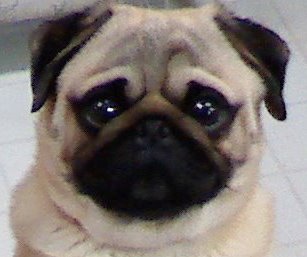
Tyler has the correct, large globular dark eyes.
All materials on these pages were created and remain private property and as such are protected under
the copyright laws of the United States of America. DO NOT copy or distribute without written permission!
the copyright laws of the United States of America. DO NOT copy or distribute without written permission!
This site was designed and is maintained by :